
Since the first time in 33 years, Stedelijk Museum Schiedam will be presenting a solo exhibition by Lou Loeber (1894-1983), whose vibrant, socially engaged, yet accessible work made her into a unique artist. While Loeber experimented with abstraction, she never implemented it as rigidly as her contemporaries Piet Mondrian and Theo van Doesburg. The reason for this was that she always wanted to keep her work comprehensible to a wide audience. The museum has a work by Loeber in its collection: the silkscreen print Slapenden (Sleepers, 1975). The exhibition also marks the launch of a programme about women artists from the 1970s who worked in an abstract style and to whom Loeber was an important source of inspiration.
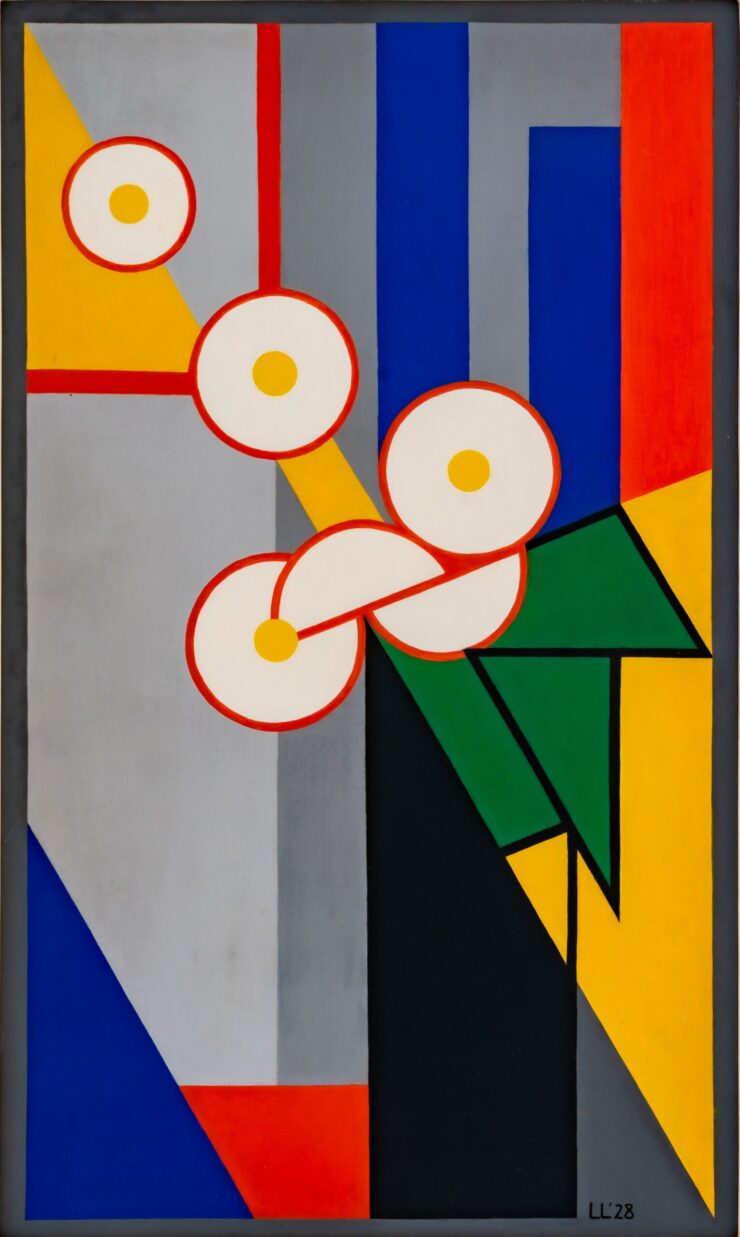
Lou Loeber, Flower still life, 1928, oil on board, Private collection, © Lou Loeber c/o Pictoright Amsterdam 2026

Lou Loeber, Arum Lilies, 1928, oil on panel, 80x 50 cm, Private collection, © c/o Pictoright Amsterdam 2026
Developing her own style
From an early age, Lou Loeber already knew she wanted to become an artist. Growing up in a progressive family, she was given all the space she needed to develop her talent. Her father even built a garden studio for her. In 1918, Loeber left the Rijksakademie in Amsterdam after three years because she found the lessens given too conservative. In the 1920s, she went on to develop a style of her own in which she combined abstraction with recognisable depictions. Although she got inspired by the work of Wassily Kandinsky and De Stijl, she always remained true to her own vision. With characteristic vivid colours, geometric shapes, and black contours she intended her work to convey a universal visual language for everyone to understand.
Inspired by the French artist Albert Gleizes, Loeber furthermore designed a system to create multiple versions of a single work, thereby applying the modernist ideal of mass production to the visual arts. By this multiplication, she was able to lower the price and thus make art accessible to a wider range of people. She also produces her work in various media, and together with her husband, artist Dirk Koning, she established an art lending service in 1932 to rent out their work at an affordable price.

Lou Loeber, Man at the Stove II, 1947, oil on panel, 45 x 34 cm, Collection Rijksmuseum Twenthe, Enschede, © c/o Pictoright Amsterdam 2026

Lou Loeber, Head (Portrait of Toon Verhoef), 1925, gouache paint on panel, 69 x 54,8 cm, on long-term loan to Singer Laren by the Cultural Heritage Agency of the Netherlands, © c/o Pictoright Amsterdam 2026
Art for everyone: accessible and connective
Despite her recognisable style, Loeber always wanted her works to be impersonal. She was, after all, interested in creating universal art, not in individual expression. She used her designs – interiors, landscapes, still lifes, and portraits – to experiment with colour, form, and composition. She was constantly searching for harmony between abstraction and figuration, which she hoped would contribute to realising a better and more socially just world. According to Loeber, art had to be both accessible and connective.
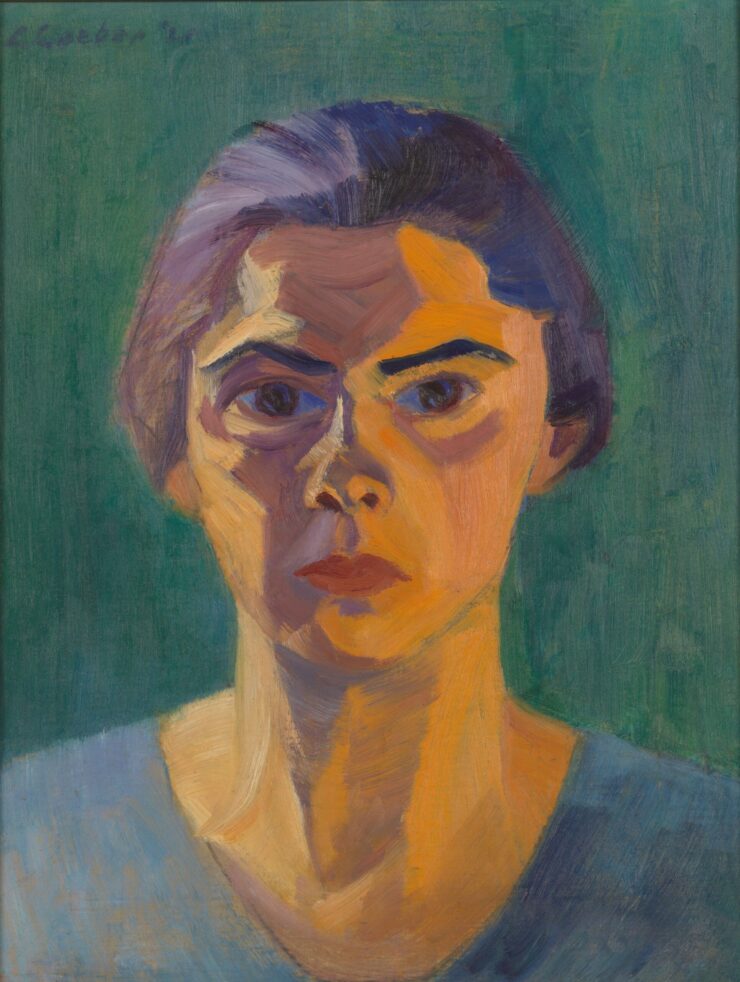
Lou Loeber, Zelfportrait, 1921, oil on canvas, Collection Rijksdienst for Cultureel Erfgoed, Amersfoort , © Lou Loeber c/o Pictoright Amsterdam 2026
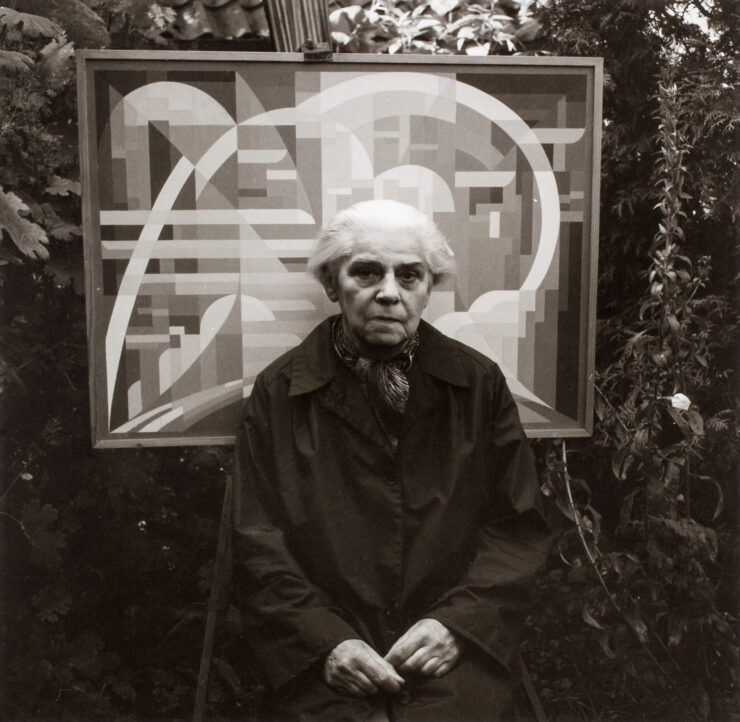
Lou Loeber, portrait by unknown photographer, Oktober 1967, Collection RKD, Pictoright, © Lou Loeber c/o Pictoright Amsterdam 2026
After the Second World War, Loeber continued to make art inspired by her socialist ideals, even though she had lost all hope that a more equal, socialist society would ever actually be realised. She nonetheless never lost her conviction that art had to be comprehensible as well as accessible to everyone. This ideal perfectly matches the ambitions of Stedelijk Museum Schiedam.
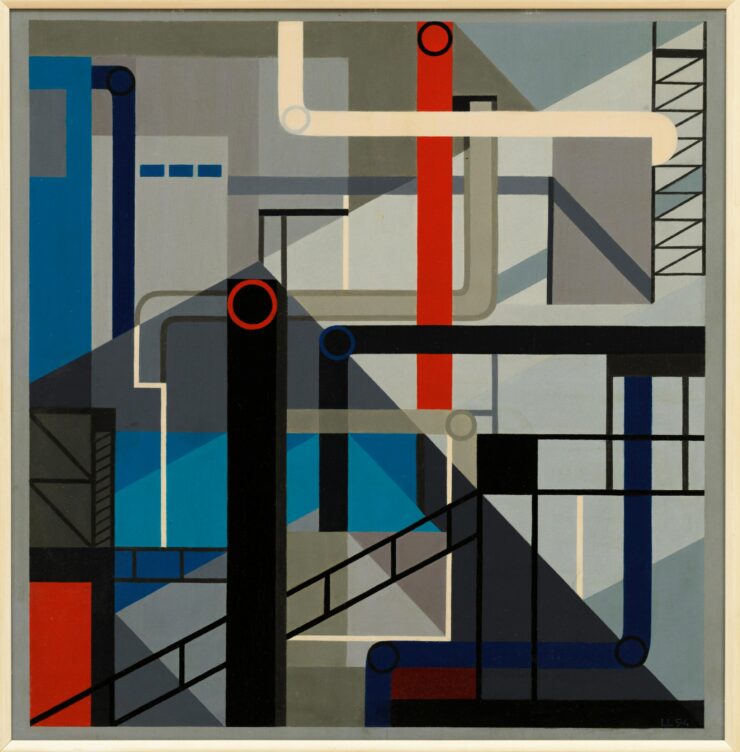
Lou Loeber, Gasfabriek in Arnhem, 1954, olieverf op panel, Collectie Museum Helmond, © Lou Loeber c/o Pictoright Amsterdam 2026

Lou Loeber, Sleepers, 1925, screen print, 65 x 65 cm, printer Rolf Henderson, 1974, Collection Stedelijk Museum Schiedam, © c/o Pictoright Amsterdam 2026
Private collections
Last year, the Stedelijk Museum Schiedam issued a call to the public: anyone who had a Loeber at home was invited to come forward. This resulted in a flood of responses. Eight works by Loeber from private collections have been added to the selection for the exhibition.
The museum also managed to bring together three paintings that Loeber made of the Schiedam windmill De Walvisch for the exhibition. Loeber often made several versions of the same subject. These works clearly illustrate Loeber’s search for simplification. In each version, the windmill and the surrounding landscape change subtly, and you see fewer and fewer details. The sails of the windmill, for example, become increasingly flat and abstract. This quest for simplification ultimately led to her characteristic, colorful and geometric style.

Lou Loeber, Mill (version 4), 1922, gouache on paper, 73,3 x 55,2 cm, Collection Centraal Museum, Utrecht, © c/o Pictoright Amsterdam 2026
‘This is the windmill on the West-Vest in Schiedam. I made a small naturalistic drawing of it in the autumn of 1921. At home, I made four different paintings of it, four successive versions.’ Lou Loeber (1980, Memories).
In 2024, Stedelijk Museum Schiedam rediscovered Loeber’s work while organising Abstract Art by Women, Then and Now. In this presentation, her silkscreen print Slapenden was shown alongside work by other women artists. This renewed appreciation also marked the point of departure for new research into women artists working in the abstract style like Corrie de Boer, Christa van Santen, Karin Daan, and Ria van Eyk, and future exhibitions of their work.
The exhibition on Lou Loeber includes not only loans from private collections, but also works on loan from the collections of, among others, the Centraal Museum, Singer Laren, Museum Belvédere, Kunstmuseum Den Haag, Rijksmuseum, Rijksmuseum Twenthe, Museum De Wieger, and the Dordrechts Museum
Publication
Published alongside the exhibition is a brochure featuring the article Lou Loeber and Her Commitment to Socialist Art by art historian Rebekka van den Berg. The article originally appeared in RODE HARING No. 17 (June 2026). The brochure is available from the museum shop for €12.50.
Thanks to
Lou Loeber. Artist and idealist has been made possible thanks to the Cultuurfonds, Foundation Gifted Arts and Gravin van Bylandt Stichting. We also thank Bruning Heintz Fine Art, Amsterdam, for their advice.