
From 14 November, Stedelijk Museum Schiedam will be presenting a new work by the Palestinian artist Susanne Khalil Yusef (1984). On 10 October 2023, the museum acquired Yusef’s work بدنا نعيش (We want to live) for its collection. With this statement, Stedelijk Museum Schiedam was one of the first museums in the Netherlands to speak out against the immense injustice the Palestinians face today, and which they have been subjected to for decades. Yusef has now been invited to create a new work for one of the museum’s attic spaces. In order to realize this, she has been collaborating with the sizeable local Palestinian community.
In 2021, the artist Susanne Khalil Yusef (1984) commissioned a blown-glass version of an Arab text in the handwriting of a good friend of hers from Gaza. The text means ‘We want to live’, a phrase Yusef and her friends frequently exchange whenever they are discussing the atrocities the Palestinians have been subjected to for decades. In 1948, Susanne Khalil Yusef’s family was violently dispossessed and exiled from their home in the city of Jaffa. Her work aims to shed light on the position of Palestinians who are scattered around the world and live in a wide variety of multi-generational diasporic communities. Stedelijk Museum Schiedam acquired the work on 10 October 2023, thereby making a firm stand against the immense suffering in Palestine. The work has been exhibited in Stedelijk Museum Schiedam’s stairwell ever since. Unfortunately, the work is just as relevant today as it was three years ago. Yusef’s blown glass words serve as a reminder that we must not look away. All human beings have the right to live their lives.

Co-creation session at Museum Vlaardingen, 2026, photo by Ahmad (Photo’s Master Studio)
For her 2026 attic presentation, Yusef is creating new work, inspired by conversations and co-creation sessions she engaged in with members of the Palestinian communities in the cities of Schiedam and Vlaardingen. The reason why these communities are so large is that, in 1963, sixty-five migrant workers from the Palestinian city of Nablus were hired to temporarily work at the ROMI margarine factory in Vlaardingen. In 1967, however, the Six-Day War led to the Israeli occupation of their land, which meant they were unable to return to their homes. Out of sheer necessity, the workers subsequently also arranged for their families to come to the Netherlands. This led to the establishment of a growing Palestinian community in Vlaardingen and its surroundings; and this community still exists today.
Key without a home
In preparation for her exhibition at Stedelijk Museum Schiedam, Yusef organized three co-creation sessions with people from the Palestinian communities of Schiedam and Vlaardingen. During these sessions they talked about their shared experiences and memories and about what people had brought with them from the country they left behind. House keys were mentioned surprisingly often. After all, a key is a tangible reminder of a home, even when that home is no longer there. A key that is passed on from generation to generation is a powerful Palestinian symbol, and a such inspired the exhibition’s title: I remember the key.
A tower of ceramics and glass
One of her new works is a tower made from ceramics and glass, based on the traditional Nablus soap stacks. This city has been known for its traditionally produced olive soap for thousands of years. Yusef cut blocks of clay by hand in the same way the soap blocks used to be cut in Nablus. She furthermore made soap shapes from transparent glass. The tower has thus been constructed from two materials, glass and ceramics, with the opaque ceramic referring to villages that still exist today, and the transparent glass symbolizing villages that were destroyed. In this way, the tower pays attention to places that no longer exist and are at risk of disappearing from the collective memory. The work raises questions about loss, memory, and the right to have a place to call home, to live, and to grow up.
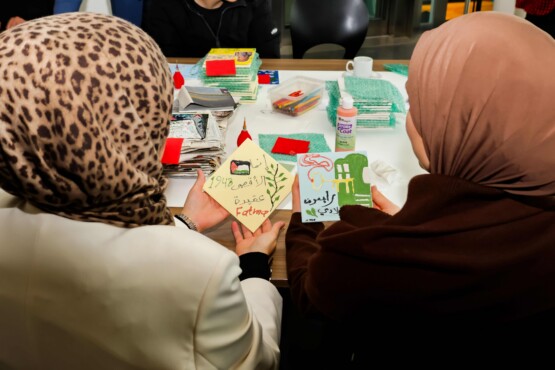
Co-creation session with Susanne Khalil Yusef, photograph by Ahmad Kellia, Photos Master studio, 2026
Collaboration with Palestinian communities in Schiedam and Vlaardingen
Another new work by Yusef consists of a pedestal that is covered in glazed tiles and carried by bronze Handalas. Handala is a Palestinian character created by the cartoonist Naji al Ali. This drawing of a ten-year-old child standing with his hands clasped behind his back became a symbol of hope, resistance, and the desire for a better future.
The tiles were made during a co-creation session with people from the Palestine communities of Schiedam and Vlaardingen. Some of the participants were third generation Palestinian refugees, while others had only recently arrived in the Netherlands. Working together to make the tiles resulted in a sense of connection and solidarity around a hidden pain. During the sessions they were able to share this pain and bring it out in the open.
The participants furthermore created a timeline using various objects. Each of these objects was a physical recollection of their home in Palestine. They also talked about what is remembered and what is in danger of being forgotten. This new installation by Yusef thus serves as a tangible representation of a collective memory.
Yusef’s collaboration with the Palestinian community ties in with the history of the region. In 1963, sixty-five men from the Palestinian city of Nablus travelled to Vlaardingen to temporarily work at the ROMI margarine factory. However, when the Six-Day War broke out in 1967, they were unable to return home. After their families joined them in the Netherlands, the Palestinian community in Vlaardingen and surroundings grew to become the largest in the Netherlands today.
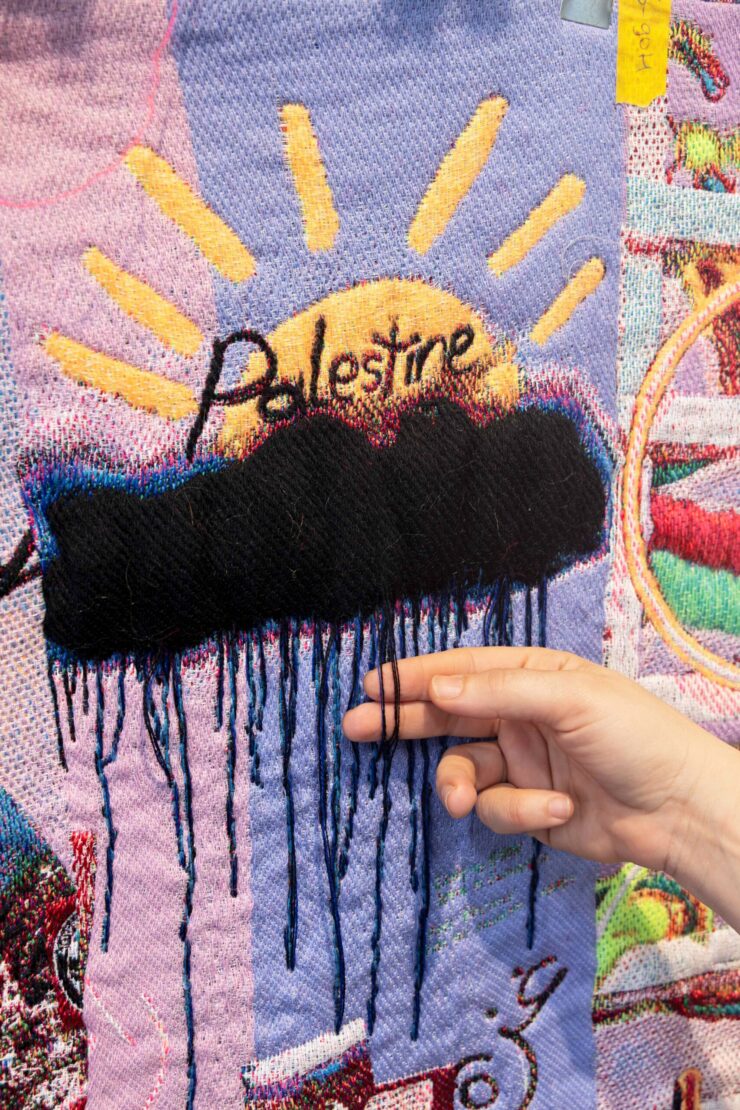
Susanne Khalil Yusef, tapestry (detail), photograph by Josefina Eikenaar, 2026
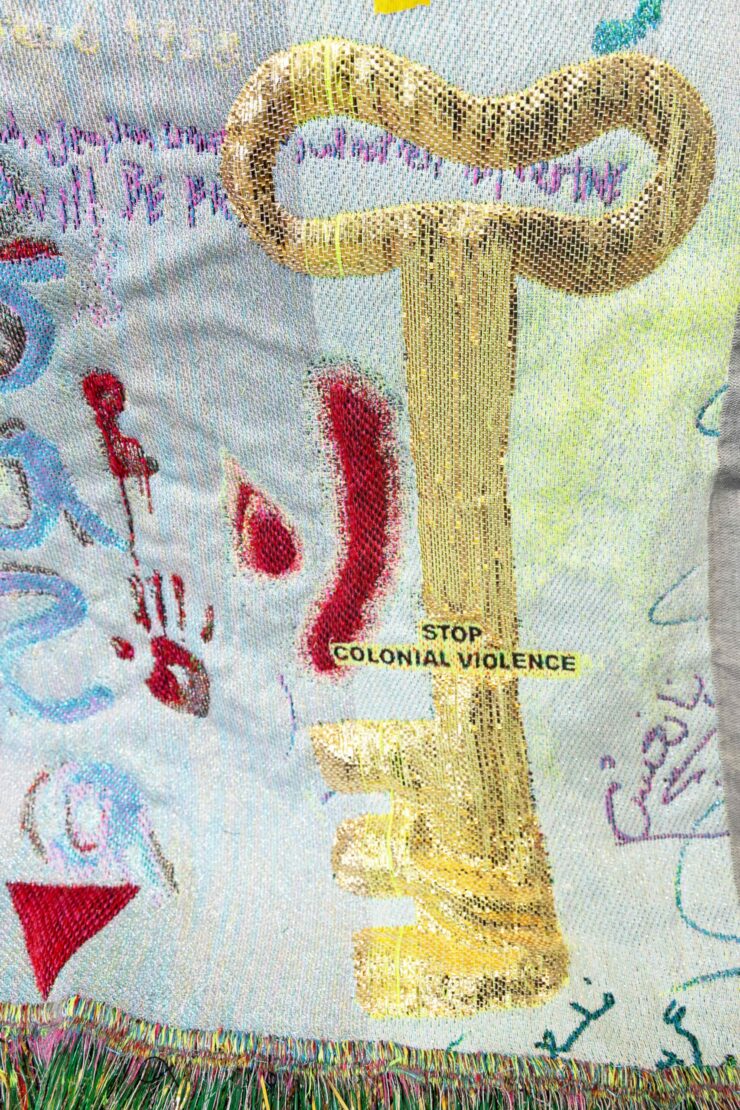
Susanne Khalil Yusef, tapestry (detail), photograph by Josefina Eikenaar, 2026
Memories in textiles
Produced at the TextielLab in Tilburg, two new tapestries by Yusef also feature the character of Handala. The works are based on a graffiti mural the artist created together with Palestinian friends, centred around a process of healing and coming together. Which stories will be forgotten en which stories will be remembered? Creating a tapestry is a slow process that requires patience and precision. The design is first converted into a pattern and subsequently woven on the loom, thread by thread. This slow pace perfectly matches the exhibition, in which Yusef expressly wants to allow space for tranquillity and reflection.

Susanne Khalil Yusef, ‘We want to live’, 2021, neon, 60 cm x 400 cm, Collection of the Stedelijk Museum Schiedam, acquired with the support of the Mondriaan Fund, photograph by Aad Hoogendoorn
Acquisition of the artwork ‘We Want to Live’
On 10 October 2023, Stedelijk Museum Schiedam acquired Yusef’s work نعيش بدنا (We Want to Live) for its collection. Modelled after the handwriting of a friend of the artist who lives in Gaza, the work features Arab letters blown in glass. These letters spell the phrase ‘We want to live’ – an expression Yusef and her friends often use when talking about the violence and injustice the Palestinians have already been subjected to for decades. With this acquisition, the museum made a firm stand against the immense suffering in Palestine. The work has been exhibited in the museum’s stairwell ever since and has unfortunately remained as relevant today as it was three years ago.
Denken aan thuis at Museum Vlaardingen
From 22 November, Museum Vlaardingen will be presenting Denken aan thuis (Thinking of Home), created in collaboration with Vlaardingen residents of Palestinian descent. The exhibition tells the story of the men who left the Palestinian city of Nablus in 1963 to work at the ROMI margarine factory in Vlaardingen, the subsequent arrival of their families, and the life they built for themselves in this city. Today, Vlaardingen is home to the largest Palestinian community in the Netherlands. On the basis of personal stories, memories, and family heirlooms, the exhibition shows how Vlaardingen residents of Palestinian descent created a new home for themselves, passed on their culture, and have been contributing to shaping the city. Together with I remember the key at Stedelijk Museum Schiedam, the exhibition offers a variety of perspectives on concepts like home, memory, and solidarity.
Pilot programme ArtBase
This exhibition is part of ArtBase. ArtBase is a content-based collaboration between Stedelijk Museum Schiedam, SCHUNCK Heerlen, and ArtBase Terneuzen. Its aim is to realize a national network of museums and art institutions in order to offer regional artists a podium and make contemporary art accessible throughout the country. ArtBase is a pilot programme for the period 2025-2027 and is made possible by the Mondriaan Fund.
Header image: Susanne Khalil Yusef in her studio, photo by Studio Another Day, 2026